
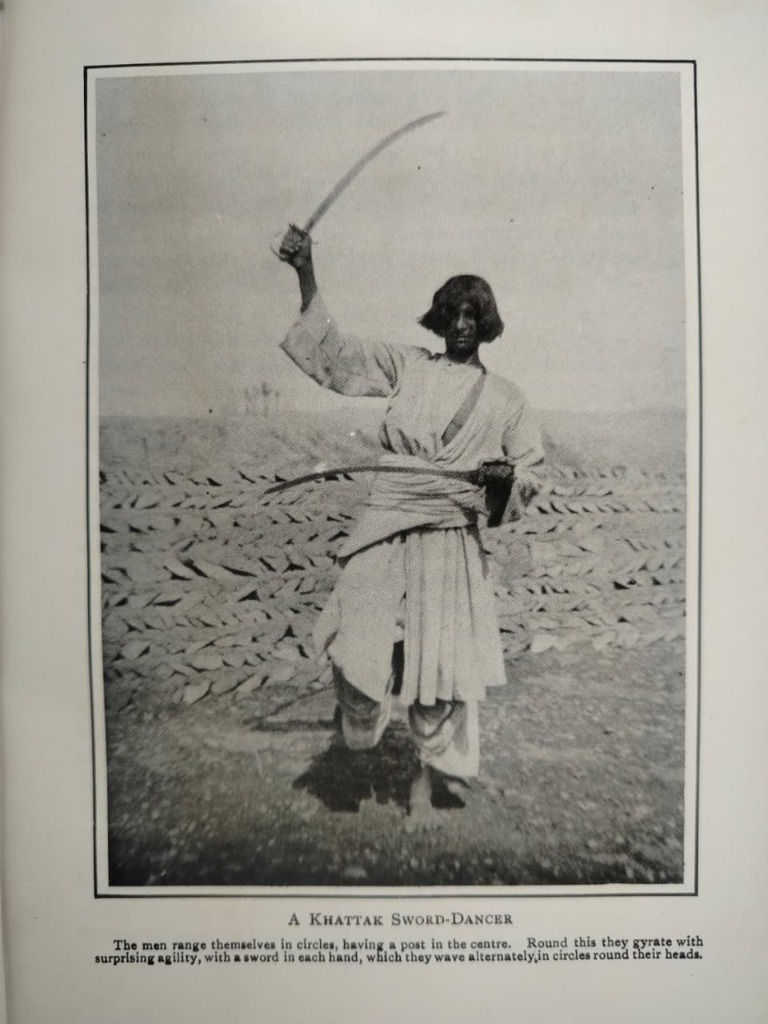
The dance of the Khattaks is universally referred to as the "Khattak Dance," as it originally was performed exclusively by the men of the Khattak tribe. However, among the Khattaks themselves, this nomenclature is considered incomplete. To the tribesmen, the dance is traditionally known as the "Bangarah," and the complete performance consists of three distinct, consecutive phases: the Bangarah (with swords), followed by the Derabi (also with swords), and concluding with the Bulbullah (without swords).
In his memoirs, colonial administrator Buster Goodwin recounts an unforgettable performance staged at the hill fort of Jatta during an official inspection visit by senior civil servant Arthur Lascelles Hoyle from Delhi, alongside Bertie Smith, the Deputy Commissioner of Kohat. The performance on a flat expanse in front of the hilltop fort brought together the finest performers from the renowned dancing villages of the Makori and Ismail Khel.
According to Goodwin, a true Bangarah requires specific traditional elements: a dark night, a roaring central bonfire of logs and brushwood, flashing swords, strong sweet kettle-boiled tea, and an orchestra consisting of two flageolets (surnai) and two drums (dhol). The flageolets in particular emit a piercing, stirring sound reminiscent of the Scottish pipes.
The performance opens with the Bangarah. Dancers, bare-headed with bobbed, well-oiled locks and brightly colored handkerchiefs knotted around their waists and necks, form a slow circle around the fire. Stepping three high paces toward the flames, executing a swift pirouette while swinging their swords across their chests, and stepping back, they circle counter-clockwise. As the drumming accelerates into a fast, hypnotic crescendo, the flashing blades and spinning fringes of hair create an electrifying spectacle. Spectators often become so overwhelmed with emotion that they toss turbans or robes into the flames as a mark of supreme appreciation.
The second act is the Derabi. Two dancers, each armed with a sword in one hand and a vibrant handkerchief in the other, step out twenty paces from the orchestra. Advancing in quick synchronized time to the drumbeat, they swirl their swords and wave the handkerchiefs high above their heads, spinning furiously like tops before suddenly dropping to their heels in unison.
The finale is the Bulbullah. In this phase, swords are laid aside. Two lead singers begin by circling the fire singing a love song in high falsetto while cupping their hands to their ears to keep perfect pitch. As the drum tempo picks up, the entire circle of dancers joins in, spinning and clapping their hands in rhythmic unison.
Originally performed exclusively upon the successful return of a war party or tribal foray, the Khattak dance evolved into a celebrated martial heritage performed across weddings, rites of passage, and historic gatherings throughout the frontier.
Sources
- 1.Life Among the Pathans (Khattaks) — Buster Goodwin, Chapter VI